
Schaeffler opens a Chinese factory using humanoids to assemble robot components
Schaeffler says six humanoids are working on component assembly in Taicang. The factory is a material industrial milestone, but public evidence does not yet establish throughput, supervision needs or labor savings.
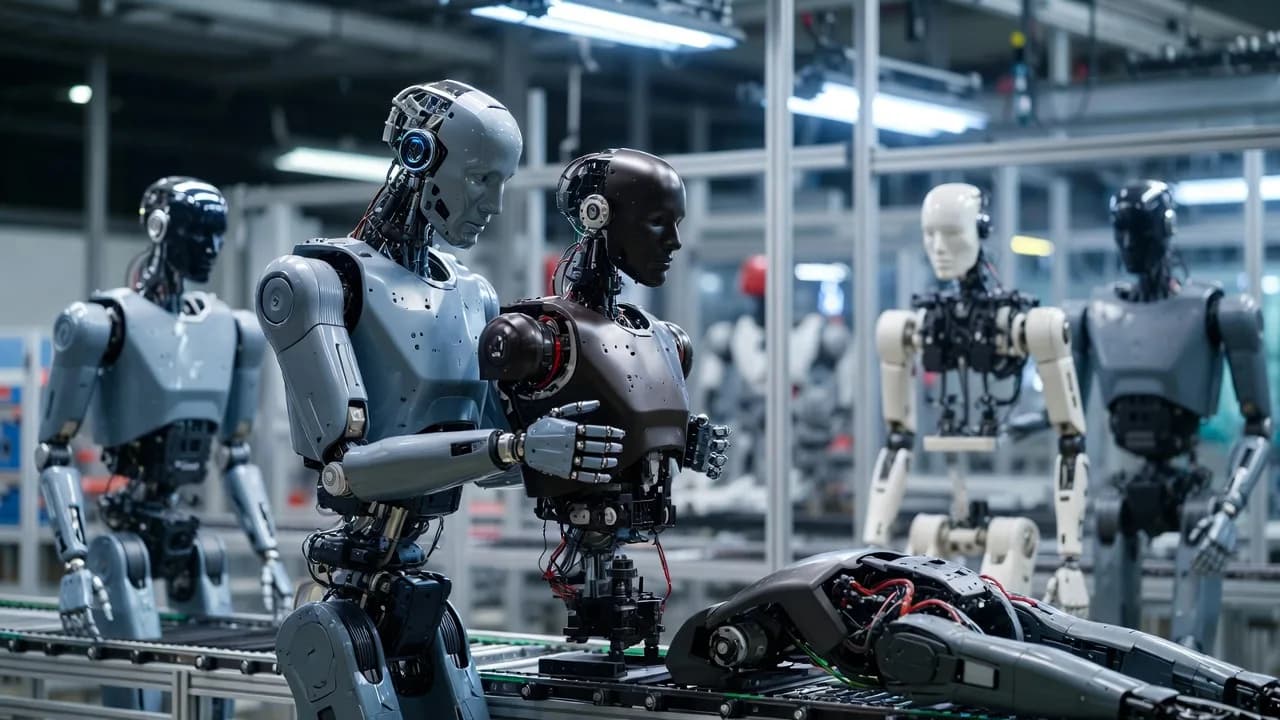
Schaeffler announced on 20 October that it had opened a humanoid-robotics factory in Taicang, China. The company says six humanoids work across five stations assembling components, within a site combining production, training, data collection and digital twins. The robots handle parts of the workflow for joint modules and actuators used in other robots. [s1]
Schaeffler announced on 20 October that it had opened a humanoid-robotics factory in Taicang, China. The company says six humanoids work across five stations assembling components, within a site combining production, training, data collection and digital twins. The robots handle parts of the workflow for joint modules and actuators used in other robots. [s1]
This is a more specific industrial claim than a staged movement demonstration: a named facility and production tasks are identified. However, the account does not publish throughput, intervention rates, uptime or comparative labor costs. It supports a manufacturer-reported deployment milestone, not independently demonstrated economic superiority or fully autonomous operation.
The company also reports around €400 million in global incoming humanoid-robotics orders after adding customers in Greater China. Orders are different from delivered products or recognized revenue, and they do not measure the productivity of the Taicang line. Keeping those categories separate prevents a commercial demand figure from being used as evidence of robot performance. [s1]
The phrase describing robots making robots requires similar precision. Assembly of selected components is not autonomous construction of a complete robot, let alone self-replication. Human-managed facilities, supply chains and engineering remain part of the system described. The important question is what proportion of the actual production process is now performed reliably by humanoids.
The strongest positive case is that testing beside production can expose failures that laboratory demonstrations miss and create operating data for improvement. The strongest limitation is that the public record comes from the supplier and gives no independent performance comparison. Follow-up should request task completion, human assistance, safety incidents and the economics of the line. Schaeffler sells components into this market and has a direct interest in presenting humanoid adoption as commercially ready. [s1]
Evidence assessment: 6/10 — Emerging credible evidence | Scoring confidence Moderate. Named facility and tasks in a supplier release; independent operating metrics are unavailable.
Interests and provenance: Schaeffler sells robot components and benefits commercially from humanoid adoption.
Sources: [s1] Schaeffler — Humanoids making humanoids: Schaeffler opens lighthouse factory in Taicang (2026-10-20): https://www.schaeffler.com/en/investor-relations/events-publications/ir-releases/ir_releases_detail.jsp?id=88222851
What we do not know
- Q: Does the Taicang announcement prove dependable autonomous factory performance? A: Not yet. Schaeffler names six humanoids, five stations and production tasks, but supplies no independent throughput, uptime or intervention record. The evidence supports a producer-reported deployment milestone, not proven economics or general autonomy. [s1]
- Q: Are robots autonomously making complete robots or replicating themselves? A: That is not what the cited evidence establishes. It describes humanoids assembling selected joint modules and components within a managed factory. The human inputs and proportion of the complete manufacturing workflow automated are not quantified. [s1]
- Q: What does this mean for the workers and people near the line? A: The release does not establish net job changes, supervision burdens or independent safety outcomes. The reported order value is not a labor or safety metric. Public-interest follow-up should examine incidents, worker experience and who can stop operations when performance is unsafe. [s1]
Sources
Interests and disclosures
- Parties identified in the article
- Schaeffler sells robot components and benefits commercially from humanoid adoption.